
Quick Reference Guide
Gas Heating Systems
The components in a gas dryer heating system are:
- Igniter. When energized with 120 VAC, it glows red hot and radiates heat.
- Flame Sensor. When the igniter gets hot enough, bi-metal contacts inside open and voltage is redirected to the coils.
- Coils. The coils open to allow gas into the burner tube.
Diagnostics
Unlike an HSI oven igniter, the current draw on the gas dryer igniter is irrelevant. The igniter needs to put out enough heat to open the bi-metal contacts in the flame sensor.
- When initially energized, most systems will supply voltage to the igniter and it will start to glow red hot, and some, but not all, of the coils will energize and will open.
- When heated to a certain temperature, the bi-metal strips in the flame sensor will open.
- When the flame sensor opens, voltage is supplied to the remaining gas valve coil, and gas is released.
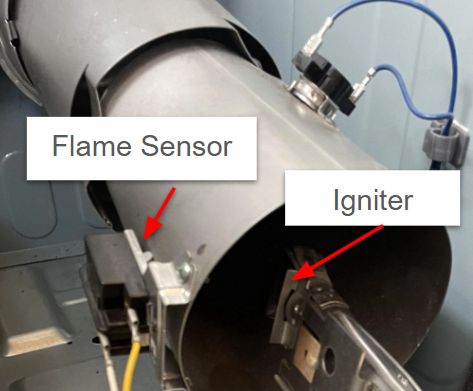
As you can see, the igniter is close to the flame sensor. When hot enough, the contacts in the flame sensor open.
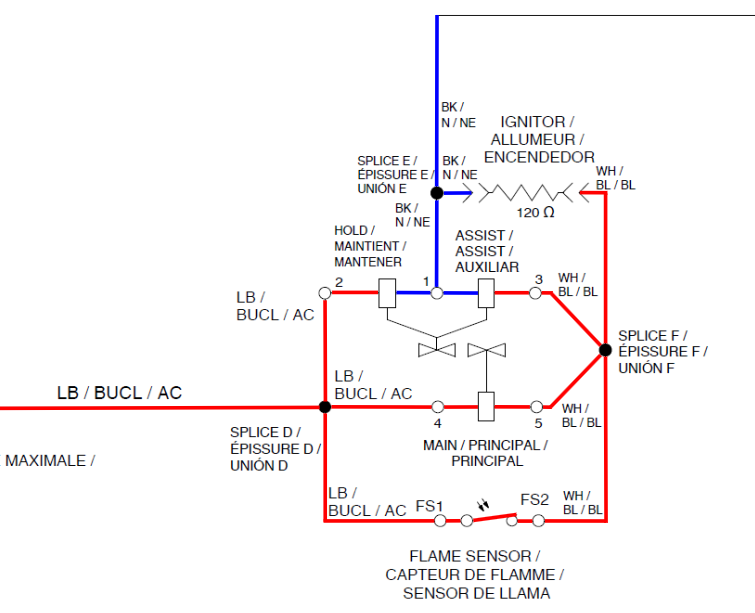
When initially energized, the circuit will look something like this:
- The igniter has line and neutral.
- The hold and assist valves have line and neutral.
- The main valve does NOT have line and neutral.
- The flame sensor is providing a “path of least resistance” around the main coil.
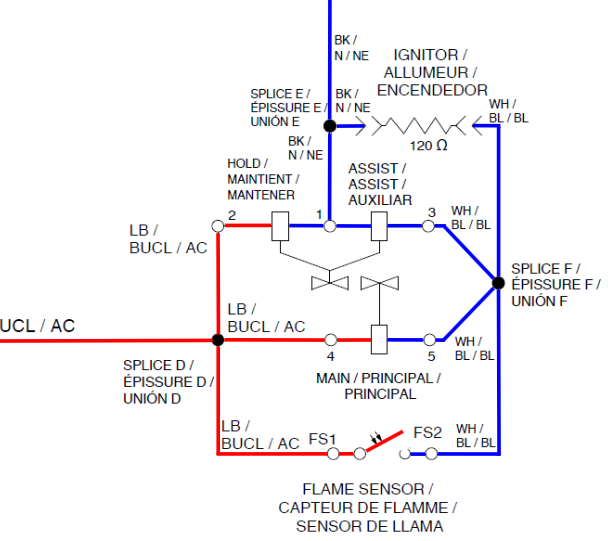
Once the igniter heats enough to open the bi-metal in the flame sensor, the circuit looks like this:
- The hold and assist valves have line and neutral.
- The main valve now has line and neutral.
- Gas should be flowing.
- The main valve has higher resistance than does the igniter, so it drops more voltage across it.
- The igniter will only get a small amount of voltage, not enough to heat.