DSI Ops
DSI Board operations use Spark Electrodes to ignite gas, rather than their HSI counterparts (the Glow Bar).
The DSI Board itself is a logic board. When the control sends a signal voltage to it for either bake or broil, the DSI then checks to ensure the valves are “in spec” and are present. If that checks good, it will then energize the correct valve, and will initiate spark.
When flame becomes present, the flames hitting the spark electrode generate a small DC voltage that the DSI board then uses to determine if flame is present. If it sees the small DC voltage, it stops the sparks and leaves the valve open.
If it does not see the small DC voltage, it stops the spark for a short while, then tries again. It will generally retry 2-3 times before stopping altogether.
Common Failures
- Sparks, ignites flames, then goes out.
- The spark electrode is likely not sending that small DC voltage back to the DSI. Try sanding down the spark electrode with a fine-grit sandpaper.
- The electrode is too far away from the flame to generate that voltage. Try repositioning the electrode closer to the burner tube.
- Sparks, smells gas, but no ignition.
- Positioning of the spark electrode is important.
- Monitor the spark electrode when you hear the spark. If you are not seeing a spark at the electrode itself, then the spark is likely occurring somewhere else – i.e., a broken wire between the DSI and the electrode.
- Visually inspect the spark electrode for any damage or carbon buildup that would be preventing the electrode from sparking.
- No Spark When Bake or Broil Started.
- Ensure the control board is getting the 120 VAC signal line from the main control board.
- Ensure the gas valves are testing “in spec” from the DSI board. If one is open, or out of spec, the DSI logic will not initiate bake or broil.
Wiring Diagram Refresher
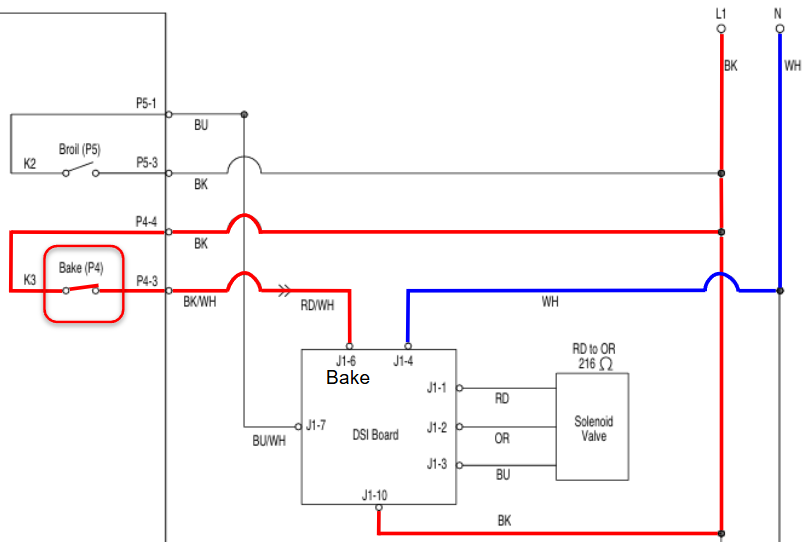
In the diagram below, we can see where voltages are when a Bake cycle is started. The control board closes a relay on the control board itself, and supplies line voltage to the DSI board to the Bake signal line. When the DSI sees that 120 VAC there, it knows that it needs to start a bake. It makes it’s checks on the valves, and if they’re good, it will open the respective one, and will initiate a spark and will monitor for that DC voltage when the flame is present.
In the diagram, it is not shown that there is DC voltage going to the valves. For this unit in particular, it will be 8-18 VDC, but you need to refer to the tech data on the unit you’re working on to be certain.