
Transformers
Transformers
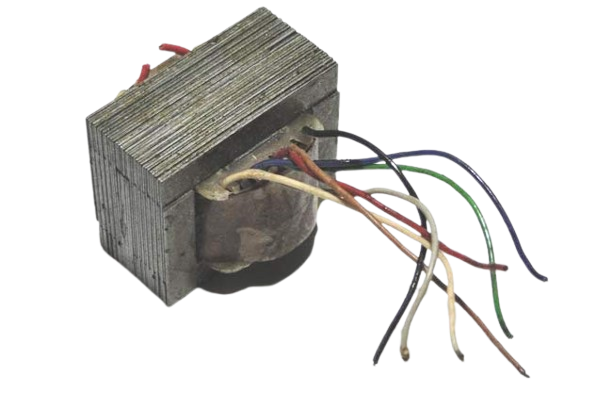
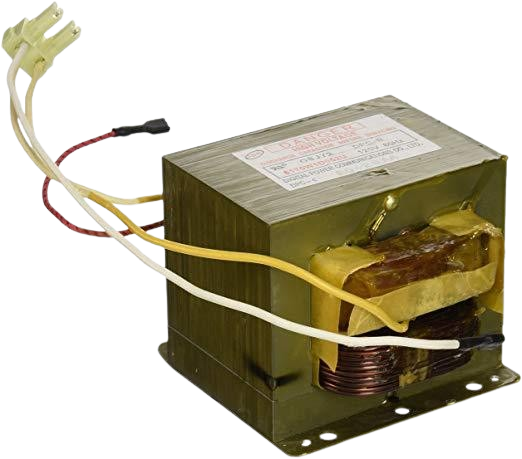
What Is a Transformer?
A transformer is an electrical device used to change the voltage level in an AC (Alternating Current) circuit. It does one of two things:
- Steps down voltage: Makes high voltage lower
- Steps up voltage: Makes low voltage higher
In appliance repair, you’ll see both types. For example:
- Lowering 120V AC (house voltage) down to 12V or 24V AC for control circuits in microwaves, refrigerators, or dishwashers. More often, you’ll see this particular type in older appliances, as newer appliances tend to use DC voltage for the low voltage components.
- Raising 120 VAC up to 2,000 VAC for Microwave Magnetrons.
Important Clarification: Transformers Work Only with AC
A transformer cannot change AC into DC. That’s the job of a rectifier.
Transformers work only on AC power because they rely on changing current direction to induce voltage.
How Does a Transformer Work?
A transformer has two coils of wire:
- Primary coil – connected to the incoming voltage (e.g., 120V)
- Secondary coil – connected to the output voltage (e.g., 24V)
These coils are wrapped around an iron core, which helps transfer the energy between them.
No direct electrical connection exists between the primary and secondary. The energy is transferred using magnetism.
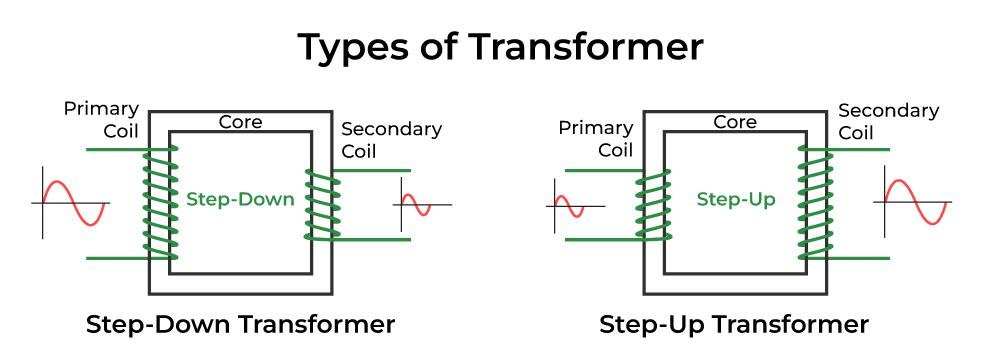
Photo courtesy of GeeksforGeeks.
Step-Down Transformer
On a step-down transformer, the secondary coils will have fewer loops.
Step-Up Transformer
On a step-up transformer, the secondary coil has more loops.
AC electricity flows into the primary coil.
This creates a magnetic field that expands and collapses as the current alternates.
That changing magnetic field induces voltage in the secondary coil.
Depending on how many wire turns each coil has, the voltage goes up or down.