
Overview
In this module, let’s take a quick minute to understand how the dryer itself is actually supplied with 240 VAC. Understanding this is critical when you suspect an issue with the house voltage supply.
Breaker Box
Voltage Basics
While we’re not electricians, it’s important to understand how electricity works. 240 VAC, as you are starting to learn, is not some magical number they’re pushing through one line rather than 120 VAC.
240 VAC is created when you’ve got 2 separate 120 VAC lines which are out of phase with one another. Remember, voltage is the potential difference between two points.
When you’re measuring 120 VAC, that’s the difference between +120 VAC and 0 VAC. Remember, though, that +120 flip flops 60 times per second. +120, -120, +120, -120, 60 times per second.
When you’re measuring 240 VAC, that’s the difference between a +120 VAC sine wave, and a -120 VAC sine wave. They flip flop at the same rate, remaining out of phase with one another.
Breaker Box Configuration
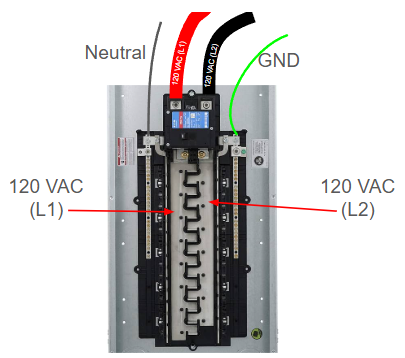
When you look at a bare electrical breaker box, you’re typically going to see 4 “bus bars.”
- Line 1
- Line 2
- Ground
- Neutral
L1 and L2 bus bars alternate spaces as the bus bar goes from the top to the bottom, as you can see in the diagram. This is intentional. When you put a double pole breaker in the breaker box, one breaker is on the L1 bus, the other is on the L2 bus. This is how the 240 VAC appliances get their L1 and L2.
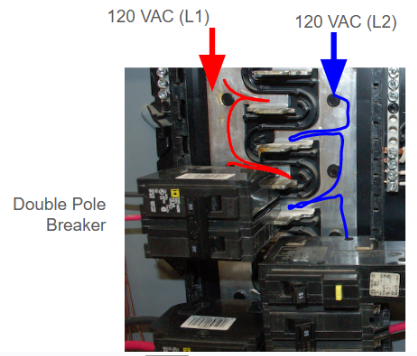
Ground and Neutral have their own bus bars off to the side.
From the breaker box, L1, L2, Ground, and Neutral all travel to the outlet that the dryer connects to. This is the same for electric ovens. (In the image below, we only see L1 and L2 wiring to the outlet.)
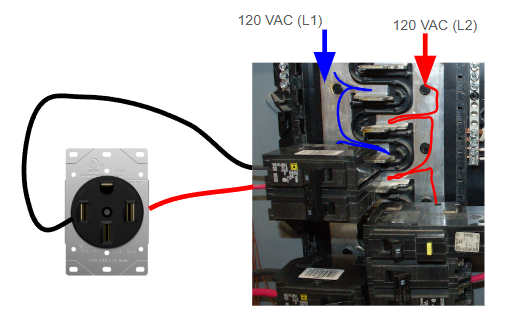
This same concept applies to electric ovens, it’s just that electric ovens have a larger breaker and larger wires. (They have more heating elements than do a dryer.)