I am pretty sure we all know what electrical outlets are. They’re in every home, and we use them pretty much on a daily basis. But as appliance repair technicians, understanding how they work and how power is supplied to them is an important key to properly diagnosing appliances.
In the dryer module, we go over the breaker box in a bit more depth, so in this module, we’re really going to dive deep into the outlet you plug your cord into and will explore some common failure points you’ll happen across. It’s important to pay attention to this chapter because there are times where the appliance is working fine, but there is an issue with the house voltage supply. You need to understand how all that works to determine if there is a failure present.
Generally speaking, when there is an issue with voltage at the outlet, the issue is no longer our problem. It becomes an electrician’s problem.
120 VAC Outlet
The 120 VAC outlet is what you have peppered throughout a house. It’s what just about everything short of electric dryers and ovens plug into.
The two most common types of outlets that you’ll see are the standard outlet, and a GFCI.
GFCI outlets are Ground Fault Circuit Interrupter outlets, and they’re generally required to be in areas where moisture is expected – in the kitchen, the bathroom, or outside. Inside the receptacle, there is a computer board and it’s constantly looking for any discrepancies in current going in and going out. If it sees something it thinks as current going somewhere it shouldn’t, it will “trip” and will cut power.
On the standard receptacle, if there is an issue with the circuit, such as a short, then the breaker is the component that will “trip” to cut power.
Whether you’re dealing with a 120 VAC standard outlet, or a GFCI, the wiring will be the same. You should have line voltage on the smaller spade, neutral connected to the larger spade, and Ground at the bottom.
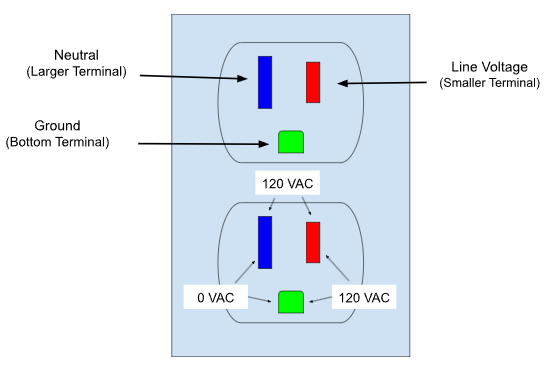
Having the proper voltage, and the proper polarity is important, especially when you’re dealing with these newer appliances with computer control boards. I have had numerous calls for various issues where the appliance appears to be “drunk,” and it turned out the polarity was reversed, or we were getting 60 VAC on each line. We’ll dive more into that in later modules, but for now, let’s visualize the outlet and where voltages should be.
240 VAC Receptacles
When we get to the appliances that require a lot of power – electric dryers and ovens – you’re going to see distinct receptacles. These receptacles and the wiring to them are capable of handling much more current than the standard 120 VAC ones.
Electric Dryer Outlet – 3 Prong
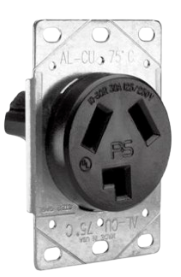
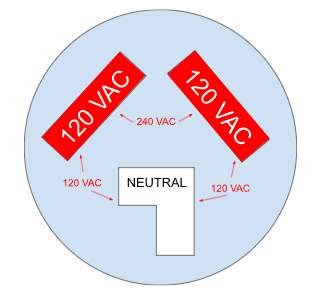
On older builds, you’ll generally see a 3 prong outlet. Line 1, Line 2, and Neutral. It can be easy to mix up the difference between a 3 prong Oven outlet, but the chief difference is that an electric dryer outlet has an upside down L shape for the Neutral at the bottom.
Electric Dryer – 4 Prong Outlet
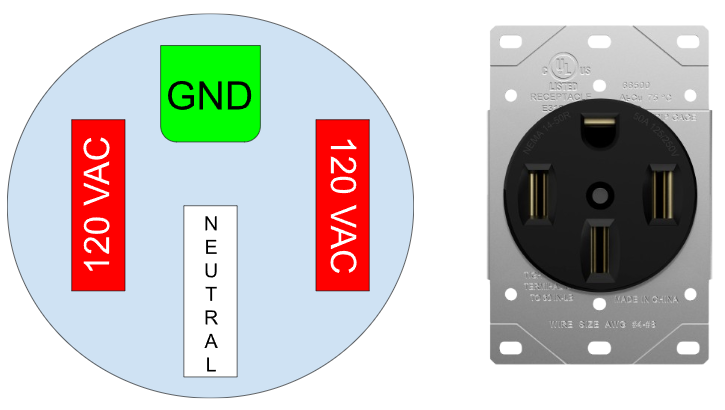
Updated electrical codes require that dryers be situated on a 4 wire outlet. In addition to L1, L2, and Neutral, there is also a Ground.
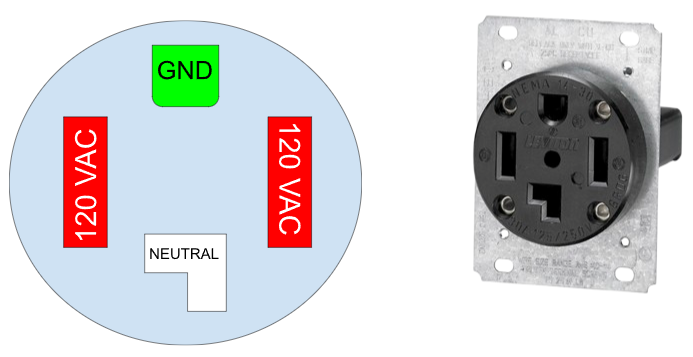
Oven Receptacle – 3 Wire
Much like the dryer 3 wire, this used to be the one used until the electrical code started to require the 4 wire connections. Notice the key difference – the Neutral plug is a straight line, not an upside down L. Still has the same voltages – L1, L2 & N.
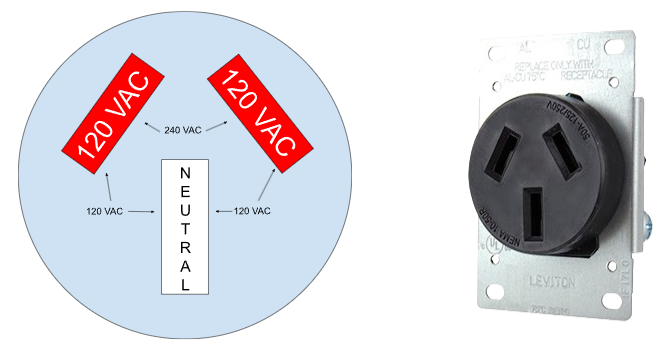
Oven Receptacle – 4 Wire
Again, much like the 4 wire dryer configuration, the 4 wire plug incorporates a ground wire.