
Washing Machines
In this section, we’ll take a deep dive into washing machines. While washers may seem complex at first—given the number of moving parts and systems—they’re actually quite manageable, especially when compared to refrigerators.
There are two primary types of washing machines: top load and front load. As their names suggest, top load washers allow you to load clothes from the top, while front load washers have a door on the front for loading and unloading.
Both styles serve the same purpose—cleaning clothes—but each comes with its own set of advantages and drawbacks. Many of these differences come down to personal preference. For example, some customers prefer front load washers because they eliminate the need to reach deep into the drum and can be placed on pedestals for added convenience.
In this module, we’ll cover the key systems and components of washing machines and explore their roles in the wash process. Then, in the next module, we’ll take a deeper look at how these components function and how to diagnose issues effectively. Keep in mind that these lessons build on each other—while some sections may seem straightforward, they lay the foundation for a deeper understanding as we progress.
Theory of Operation
Key Operations in All Washing Machines
Water Fill
All washing machines must first fill with water before any cleaning action can begin. Water fill is done by a water inlet valve, which regulates the flow of cold, hot, or mixed water into the drum. Depending on the model (generally older ones), some of the fill times are controlled by a pressure switch. Line or neutral routes through the pressure switch and then to the fill valve. When the water level rises to a certain level, contacts in the pressure switch open the path of electricity to the fill valve, stopping the flow of water until the timer advances to the wash cycle.
 In other units, you’ll find a pressure sensor, which functions primarily as a sensory input device. It detects air pressure changes in the tube caused by the water level. Inside the sensor, a diaphragm flexes in response to the pressure, triggering electrical contacts. The control board then monitors which contacts are closed to determine the water level inside the unit.
And then there are some units that have a pressure transducer on the control board itself, and it does the same thing as the pressure sensor, it’s just not a separate component. The pressure transducer on the board converts pressure to an electrical measurement.
While the terms can be and are used interchangeably, when we technically think about it, a switch is something that has very low resistance and opens and closes a circuit. Think about the switches you have in your home that turn on and off your lights. A sensor, on the other hand, senses and then reports. On units with a pressure switch, you will see them wired in series with the water inlet valve. And on units with a control board, you will see the pressure sensor wired directly to the control board, or built into the board.
Wash Cycle (Agitation)
After filling, the washer initiates the wash cycle. The primary function of this stage is agitation, where the mechanical action of the washer moves the clothes through the soapy water. Agitation serves to loosen and remove dirt from fabrics. In top load washers, this is often achieved by a central agitator or impeller, while front load washers use the tumbling motion of the drum. Despite the difference in mechanics, the purpose remains the same: efficient cleaning through the movement of clothes and water.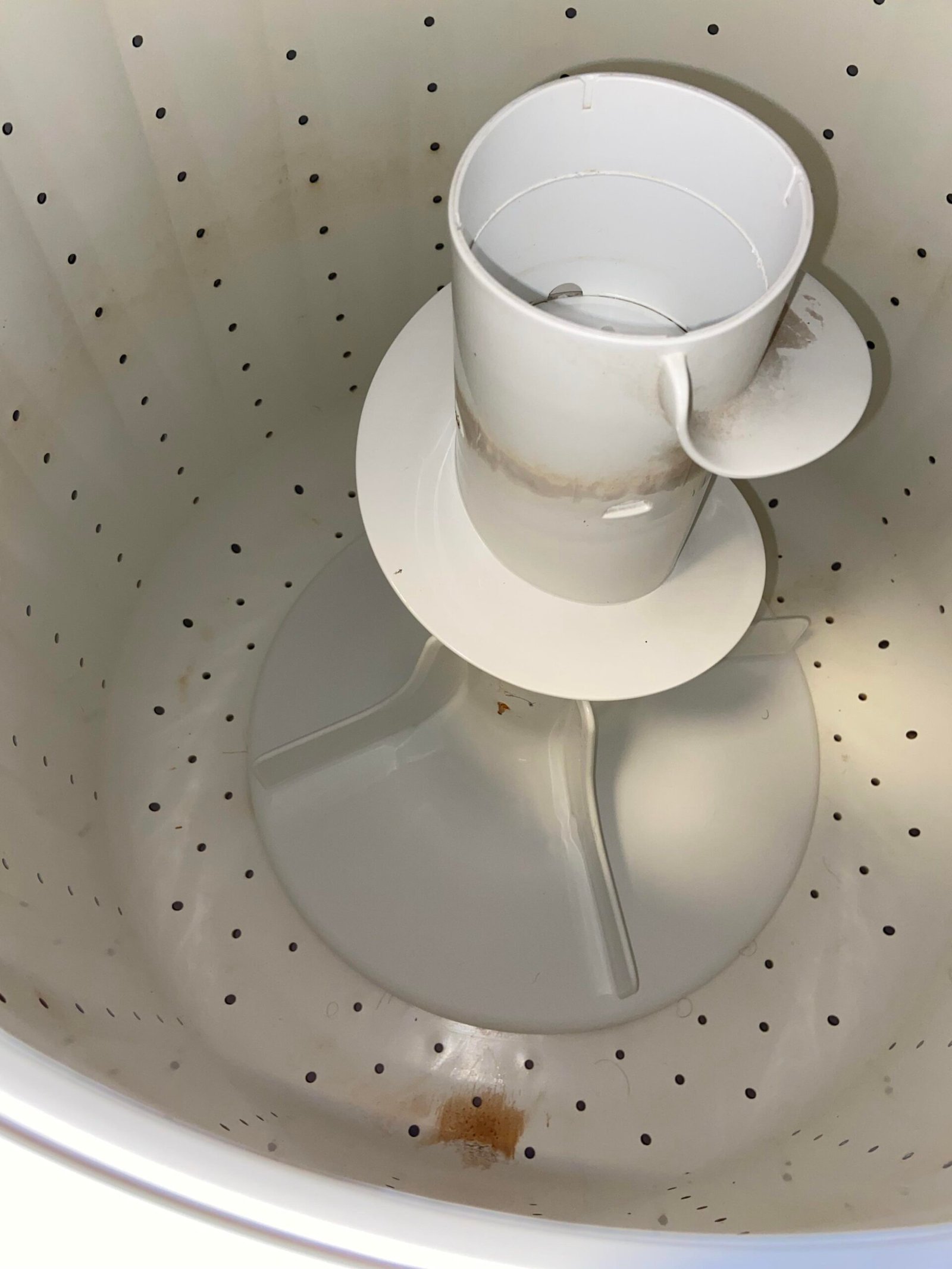
There are a few varieties of impellers vs. agitators that you’ll see on top load washers. Some have the traditional agitator, which is the arm that comes up through the center of the drum. On these, they’ll generally have angled fins, and these are designed to “agitate” the clothes. And on others, you’re going to see an agitator plate instead, which does not come up the center of the tub.
A common call you’re going to get is when a customer buys a new unit, and they think it’s not filling with enough water. You find out that their previous unit had an agitator, but their new one has an agitator plate. On units without an agitator plate, it’s important to understand why the wash cycle is also referred to as “agitation.” When we “agitate” clothes, we are causing friction amongst them. This allows the soap to rub into the garments and for it to clean the dirt that has settled in. When we remove the agitator and replace it with an agitator plate, the washer needs to use less water to generate more of an agitational force.
Think of it like this: When you go to wash your hands in the sink, do you fill the sink all the way up and then slosh your hands through it? Or do you let your hands run under the flow of water, and you rub your hands together to allow the friction to really clean them? Same concept applies to washers with agitator plates. We want the clothes to rub against one another, rather than slosh around in the water.
(Again, this is model dependent, and do not allow this concept to misguide you if the unit is actually not filling with enough water.)
Rinse Cycle
Once the wash cycle is complete, the machine must rinse away the detergent and the dirt. During this stage, fresh water is introduced to the drum, and the washer cycles through motions similar to agitation, but without soap. This ensures that residual soap is removed from the fabrics.
When a customer is using too much soap, or they are using Non-HE (High Efficiency) detergent, then this stage will have difficulty removing the soap. Customers might notice that their clothes are still a bit soapy at the end of a cycle, or there might be white streaks or a filmy substance on their clothes.
Draining
All washing machines need to drain water throughout the cycle. This is achieved using a pump that expels the water through a drain hose. Draining serves a few purposes when considering the theory of operations, and some of those are: it drains the dirty water out, and it works toward maintaining balance during a spin cycle.
A common issue that can occur with regard to draining is that the drain tube is installed incorrectly. Most of the appliances you work on will have an Installation Guide, and in this guide you will find proper methods.
One crucial detail that’s often overlooked is the air gap. When inserting the drain line into the standpipe, it should extend no more than 4.5 inches into the plumbing. If the drain tube is submerged in water, it can create a siphoning effect when the drain pump shuts off, causing water to flow back into the washer.

Spin Cycle
In the spin cycle, the washer spins the drum at high speeds to extract as much water as possible from the clothes. This reduces drying time and energy use. For top load washers, the clothes are spun around a vertical axis, while front load washers spin horizontally. Regardless of the style, centrifugal force extracts water from the clothes in this phase.
Suspension Systems
Both types of washers have suspension systems that work to mitigate vibrations during spinning.
-
- Top Load Washers: These typically use suspension rods that have springs on them to keep the tub assembly level. You will often find 4 of them, one at each corner, and if any one of them starts to loose tension, then you’ll be finding the tub banging around a lot. It’s always best practice to replace all the suspension rods at the same time, rather than going for just the one you think is failing.
- Front Load Washers: Front loaders use a more sophisticated suspension system, and this generally includes shock absorbers, much like what you’d see in a car, and they also will generally have springs that connect the top of the tub to the housing.
Controls
Just like any appliance, a washing machine needs something that commands the different components to do specific things during various points throughout the cycle. On older units you’re going to see a mechanical timer. When voltage is supplied to the timer and when a selection is made, the timer advances at the 60 seconds per minute rate. Inside, a wheel with notches rotates, and those notches push up or let down electrical contacts, which make contact with other metal contacts. When those contacts are made, voltage is sent to a respective load until the timer wheel notches progress and break that electrical contact.
Control boards are what you’re going to see more of because they’re more economical. They can be programmed with logic to offer more cycle options, they can improve energy efficiency, and they can generally self diagnose (in the terms of error codes). Unlike mechanical timers, control boards rely on sensory input by means of thermistors and sensors. This is why it’s imperative that you understand the theory of operations of each component and what they do, that way you can better diagnose. (We’ll learn more about logic in the Control Logic module.)
Detergents & Cleaning Agents
Without cleaning agents, washing clothes is essentially just agitating dirty laundry in water. While this may provide some level of cleaning, it won’t deliver the thorough results most people demand. Some washers are designed with designated compartments for detergent, and many modern models even feature bulk dispensers. These allow users to fill a reservoir with detergent, which is then automatically dispensed in precise amounts using specialized solenoids.
When servicing today’s machines, it’s crucial to consider the type of detergent the customer is using. Most units are High Efficiency (HE), meaning they require HE detergent, which is more concentrated and designed for lower water usage. Using the wrong detergent or too much of it can lead to excessive suds and poor rinsing.
Water temperature also plays a key role in detergent performance. Most detergents won’t activate properly below 65°F. This is an important factor when troubleshooting complaints about clothes remaining soapy after a wash cycle. If the machine itself is functioning correctly, the issue may be that the detergent isn’t dissolving as intended. Understanding how and when detergents activate is essential for effective diagnostics. Using more is generally not better. In fact, with the brand new appliances on the market today, you’ll typically only need about a tablespoon’s worth.
Common Components
Despite the differences in design, both washer types share several common components:
Water Inlet Valve
Controls the flow of water into the washer. On all washers, you’re going to see at minimum 2 inlet valves – one for cold, and one for hot. And depending on the washer, you might see a few more that complete other tasks, such as for bleach and fabric softener.
 When we are dealing with water coming into the unit, the washer has to use what the house is supplying. So, if you’re opting for a cold water wash, it will activate the cold valve. If you’re going for a hot water wash, it will activate the hot valve. But what if you want a warm water wash? Well, it will alternate the hot and the cold to achieve this.
Some washers simply use a timed alternation cycle between hot and cold, and some washers will use an NTC thermistor. An NTC thermistor is a Negative Temperature Coefficient temperature measurement device, and all this means is that when temperature increases, the resistance value decreases. And vise versa, when the temperature increases, the resistance value decreases. These are optimal for a lot of settings as they are relatively precise. Control boards look to the thermistor readings to determine how much hot and cold water to add to achieve the desired temperature.
Some customers will also decide that since they do not ever use hot water washes, they might as well just turn off the hot water valve. This is always something you should keep an eye out for, as some units will not operate and will present an error code if it is trying to call for hot, and is not seeing that happening because the customer has the hot valve off. And further, some units look to the thermistor to ensure there is a minimum temperature. If the cold water is less than 65°F, it will try to open the hot valve to bring that up.
Drive Motor
Powers the drum or agitator’s movement. On older units and still on a lot of units today, this will be a typical 120 VAC motor that spins a belt which is attached to a pulley, which is what drives the basket. You’ve also got motors that connect to the transmission by means of a coupler.
You’re also going to see BPM motors. These are Brushless Permanent Magnet motors, and it generally comes in the form of a Rotor and Stator. The easy way to remember which is which is in the name. A Rotor rotates, and the Stator stays stationary, or it “stays.” The stator is the circular component with a lot of copper coils. The control board sends voltage to different parts of the stator at obscenely fast rates, which then generates a rotating magnetic field. The Rotor is the circular counterpart that is composed of … you guessed it, magnets. So, when the control board wants the drum to spin, it sends voltage to the stator in a very precise manner that ends up propelling the magnets in the rotor away from the magnetic field in the stator. (More on this and on commutation in the next modules.)
Drain Pump
Removes water from the washer during the drain cycle. You will generally find these at the lowest point in the washing machine tub assembly. They have an impeller that rotates fast and propels the water out of the drain tube and into the house standpipe.
The thing to remember about washers and the drainage systems is that we are dealing with gravity. If you were to lay the drain hose flat on the ground behind the washing machine and then start filling it with water, the water would flow right out. Therefore, we need a high loop, much like with dishwashers, otherwise the unit might just keep filling but never actually get to the level it needs to be at.
Door/Lid Lock
The washer’s door lock (front load) or lid latch (top load) ensures the unit does not operate while open, preventing accidents and ensuring safety.
Depending on the model, this mechanism can be a simple switch that interrupts power to specific components or a locking system that physically prevents the door from being opened after a certain point in the cycle.
Older top-load washers typically use a basic switch, allowing the lid to be opened at any time during the cycle. However, many modern machines are equipped with a locking mechanism that keeps the lid or door securely closed while the washer is running. While this may seem like an inconvenience, it is a critical safety feature designed to prevent water spills, interruptions, and potential injury. We’ll dive deep into their operations and testing them in the next modules.
Summary
Understanding the theory of operations in washing machines is key for technicians working on different models and brands. While top load and front load washers may look different and use varied mechanisms for washing, their core operations—filling, washing, rinsing, draining, and spinning—remain consistent. Mastery of these processes provides a strong foundation for diagnosing and repairing any washer, regardless of its make or model.
It is also important to remember that while there are some core features common amongst all washers, you’ll need to refer to the technical data for the appliance you’re working on in particular. You’ll be able to take what you learn here and know how the washer works before you even arrive!