
Professional Appliance Repair Training
Learn Dryer Repair:
Master The Heat & Airflow
Stop guessing with parts. If you want to learn dryer repair correctly, you need to understand the engineering logic behind gas and electric diagnostics, thermal fuse failures, and airflow dynamics.
Start This Course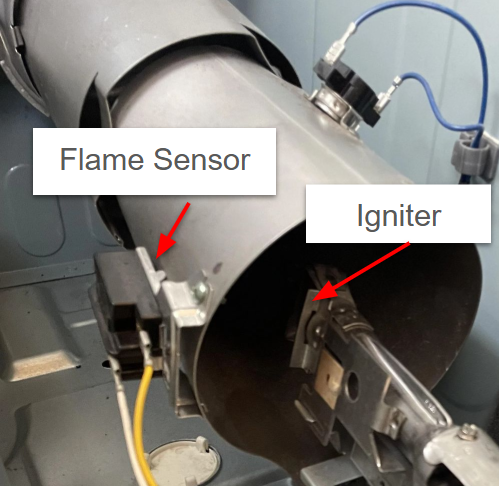
Beyond “Changing The Belt”
Most dryer calls aren’t broken belts. They are airflow restrictions and hidden electrical failures. To truly learn dryer repair, you must know how to diagnose the root cause, not just swap parts.
Dryer Not Heating
Is it the element, the thermostat, or the motor centrifugal switch? We teach you to trace the 240V circuit and isolate the open component in minutes using nothing but a multimeter and a schematic.
Airflow Physics
A dryer that takes too long to dry is rarely “broken.” It’s usually choked. Learn to prove airflow restrictions using temperature differentials, allowing you to confidently advise customers on vent cleaning.
Gas vs. Electric
Don’t fear the gas valve. We demystify the “Click-Click-Whoosh” of gas ignition coils and flame sensors so you can work safely on both systems. You will learn to identify a weak coil versus a bad igniter instantly.
The Electrical Roadmap
Reading Dryer Schematics
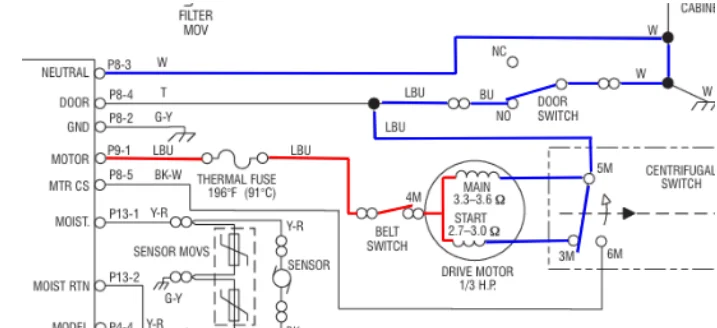
Dryer circuits are the perfect place to master schematic reading. Many technicians find wiring diagrams intimidating, but we break them down into simple, logical paths: the Motor Circuit (120V) and the Heater Circuit (240V).
The Secret to Speed: Once you learn to understand dryer wire diagrams (which we go over in detail), you’ll honestly start to love repairing dryers. Why? Because you can make a majority of your tests directly from the control board or timer, without much disassembly at all. Instead of tearing the machine apart, you test from the top and verify the failure.
- ✓ Tracing the Centrifugal Switch
- ✓ Understanding Timer Charts
- ✓ Identifying Series vs. Parallel Loads
Modern Diagnostics
Thermistors & Control Boards
Old dryers used simple thermostats that clicked on and off. New dryers use NTC Thermistors and computer logic to constantly monitor heat levels. If you want to learn dryer repair for the modern era, you must know how to test resistance values (Ohms).
We teach you how to verify if the computer is seeing the correct temperature or if it’s being “tricked” by a drifting sensor. This is the difference between a parts changer and a technician.
View The Syllabus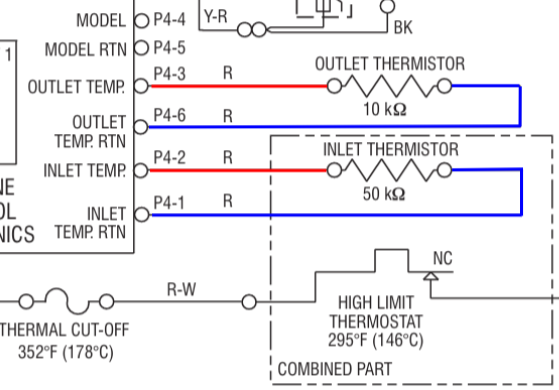
See The Training In Action
Supplement your coursework with deep technical dives. Check out our free resources for diagnostic examples and theory to help you master the trade.
Diagnostic Videos
Watch step-by-step troubleshooting guides, live multimeter testing, and component teardowns. See real-world examples of how we apply the theory.
100% Positive Rating
Viewer approved help
Tech Podcast
Deep dives into the science of repair. We break down electrical circuits, schematics, and error codes in a way that makes complex engineering easy to digest.
“Amazing info! Thank you for the hard work”
— Jp Rivera, Listener
Start Your Journey
Choose Your Training Path
The Dryer Repair module is included in our Certified Professional bundle.
Fundamentals
Perfect for beginners. Learn electrical theory, multimeter usage, and the core “Theory of Operation” for major appliances.
- ✓ Electrical Theory Basics
- ✓ Multimeter Training
- ✓ Self-Paced Access
Certified Professional
Master diagnostics, schematics, and business skills. Includes the Dryer Module and comprehensive certification.
- ✓ All Repair Modules (Dryer Included)
- ✓ Microwave Course Included (Free)
- ✓ 1-on-1 Mentorship Sessions
- ✓ ATA Official Certification
Microwave Specialist
Add high-voltage microwave diagnostics to your skillset. Safe discharge procedures, capacitor checks, and magnetron testing.
- ✓ High Voltage Safety
- ✓ Magnetron Diagnostics
- ✓ Door Interlock Switches