
Voltage Potential
Voltage potential is the difference in electric potential energy between two points in a circuit. It’s what pushes electrical current through a wire — like pressure pushes water through a hose.
You can think of it like:
Voltage potential = electrical “pressure” between two points.
Understanding voltage potential is an extremely useful tool, as understanding it will help you to determine if you’re missing line or neutral at a load, and will help you to trace down where you’re missing it.
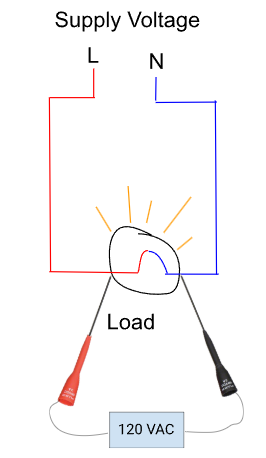
In this example, we have a closed circuit. The load has an uninterrupted path to line and neutral.
- Line is 120 VAC.
- Neutral is 0 VAC.
There is a potential difference of 120 VAC between the two points at which the leads are placed.
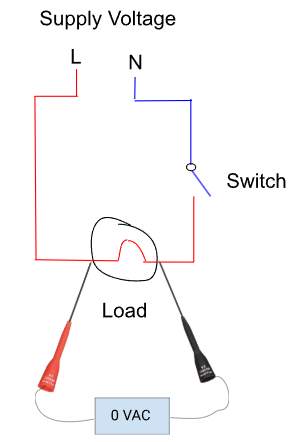
Now, take a look at this diagram. The exact same load, but there is a switch on the neutral line that is open. When we test at the same points as before, we no longer see 120 VAC, we see 0 VAC, even though 120 VAC is present.
Voltage potential is the potential difference between two points. Both the points that we are testing at here are 120 VAC. They are the “same side of the line.” There is no voltage potential between the same two points.
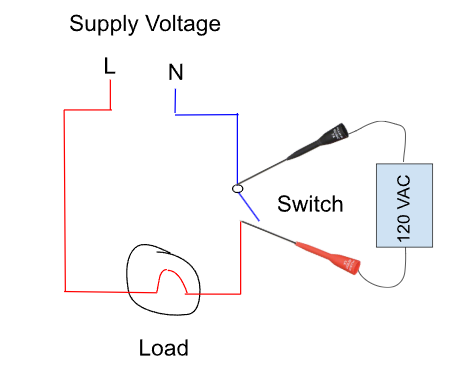
In this instance, we have our leads placed on either side of the switch, which is open. We see 120 VAC.
Having it colored in helps, but in the field you’re going to need to use your imagination on where line and neutral should be.
We are reading 120 VAC here because there is a potential difference between the two points we are testing at.
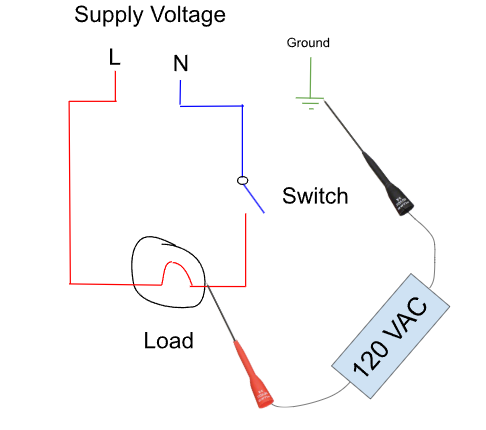
And in this example, when we have one lead on the neutral side of the load, and the other lead on chassis ground, we again have a voltage potential difference between the two points.
Ground is a known 0 VAC source.
This is a great method to use to determine if you’re missing neutral in a circuit.